How to Register a Business in Nova Scotia
Updated: July 2026. Government fees below were checked against Nova Scotia Registry of Joint Stock Companies pages in July 2026.
Starting a business in Nova Scotia usually means registering with the Registry of Joint Stock Companies, although a few narrow exceptions apply. For a sole proprietorship, budget $129.07 for the usual Atlantic name search and registration, then one to two weeks for processing. A Nova Scotia limited company costs $260.52 with the same name search and normally takes three days after the name is approved.
The filing is the easy part. The decision worth slowing down for is your structure: a sole proprietorship is simple; a corporation creates a separate legal entity but also commits you to annual filings, corporate records and a T2 tax return. This guide covers both routes, plus taxes, licences and the work that starts after the certificate arrives.
Do you need to register a business in Nova Scotia?
Most businesses and non-profits operating in Nova Scotia register with the Registry of Joint Stock Companies. The narrow exceptions are worth checking before you pay a fee:
- A sole proprietor or partners using only their exact personal names.
John Smithis different fromJohn Smith ConsultingorJohn Smith & Associates. - A corporation, sole proprietorship, partnership or business name formed and registered in New Brunswick.
- A sole proprietorship or partnership whose only purpose is farming or fishing.
The registry filing is public. So are the business name and other information you submit. If privacy is part of why you're choosing a structure, work through the registered-office and director-address requirements before filing, not afterwards.
What is the Nova Scotia Registry of Joint Stock Companies?
RJSC is Nova Scotia's corporate and business registry. It approves names, records registrations and incorporations, issues certificates, and handles annual renewals and changes.
You can create an RJSC account or sign in to file. If you are trying to confirm an existing business rather than register one, use the public business search. It shows names, addresses, registration status, recognized agents, partners, directors and officers. The registry can't choose a structure or prepare legal documents for you; that's where an accountant or lawyer can be useful for a fact-specific situation.
How much does it cost to register a business in Nova Scotia?
Here are the government fees most founders will see. A name reservation is separate from the registration or incorporation fee unless the business is a numbered company or falls into another no-fee reservation category.
| Structure or filing | Initial government fee | Annual renewal | Typical timing |
|---|---|---|---|
| Sole proprietorship | $68.55 | $68.55 | 1–2 weeks |
| General partnership | $68.55 | $68.55 | 1–2 weeks |
| Limited partnership | $199.35 | $37.40 | 1–2 weeks |
| Limited liability partnership | $311.45 | $93.40 | 1–2 weeks |
| Nova Scotia limited company | $200.00 | $118.35 | 3 days |
| Corporation incorporated in another Canadian province or territory | No cost | No cost | 1–2 weeks |
| Federal or foreign corporation | $22.84 per month, based on the months until its anniversary | $274.10 | 1–2 weeks |
Name reservation: an Atlantic-region search is $60.52; a Canada-wide search is $75.58. If you supply a Nuans report dated within the prior 90 days, either search costs $15.12. The reservation result normally takes two days and is good for 90 days. Check the current name-reservation rules and fees before paying, because the schedule can change.
Those timings are service standards, not guarantees. RJSC is reporting processing delays as of July 2026, so check the registry's live processing dates before planning around a certificate date.
The federal route is the common sticker-price trap. A federal incorporation costs $200 online, but a federal corporation operating in Nova Scotia normally also needs extra-provincial registration and its $274.10 annual renewal. Add the $12 federal annual return and the recurring registry bill is $286.10, compared with $118.35 for a Nova Scotia company. Compare the whole annual admin bill, not just the incorporation screen.
Government fees also aren't the whole cost of incorporating. A corporation needs records, annual filings and a T2 corporate tax return every year, and the professional help behind those usually costs far more than the registry ever will. How to Incorporate in Nova Scotia breaks down the annual numbers.
Choose the right Nova Scotia business structure
For most one-person businesses, this is the practical decision:
| Structure | When it is usually a fit | Main trade-off |
|---|---|---|
| Sole proprietorship | You are testing a service business or working alone and want the least administration. | You and the business are not separate for liability or tax purposes. |
| Partnership | Two or more owners are operating together. | Put a written partnership agreement in place; each general partner can create obligations for the partnership. |
| Corporation | You need a separate legal entity, plan to bring in investors, or expect to retain profits in the company. | More filings, records and professional costs every year; limited liability does not protect you from every claim or personal guarantee. |
There are less-common options. A limited partnership has at least one general partner and one limited partner. A limited liability partnership is for eligible regulated professions and requires confirmation from the profession's governing body. A Nova Scotia unlimited liability company (ULC) is a specialist structure, often discussed for cross-border ownership; incorporation and annual renewal are each $1,144.90, so get Canadian and U.S. tax advice before choosing it. A numbered company avoids the paid name search, which is useful if a market-facing operating name can be registered later.
How to register a sole proprietorship in Nova Scotia
Honestly, this is usually a straightforward filing once the name is clear.
- Choose and reserve the name. Search the RJSC and the Canadian Trademarks Database first. A registry approval isn't a trademark clearance, so don't treat it as one.
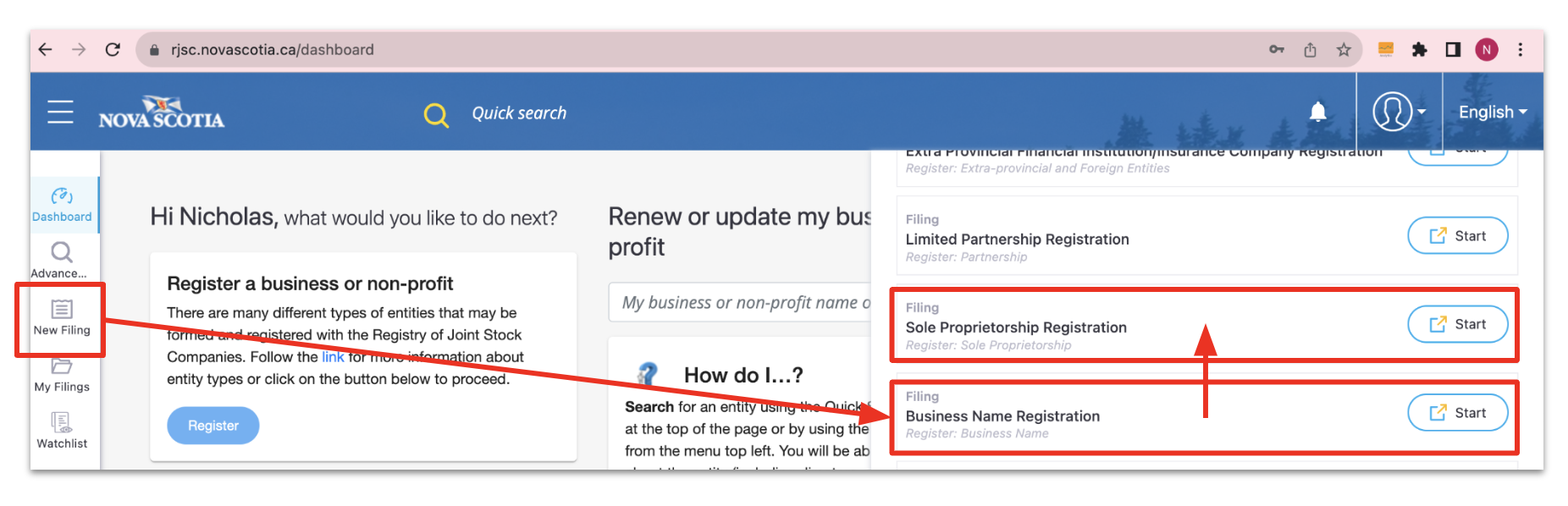
- Create an RJSC account. Use the registry portal and start the Sole Proprietor Registration Form.
- Complete the form and pay $68.55. Include the required supporting information and submit it.
- Keep the certificate and Business Number. If the application is complete, RJSC issues a Certificate of Registration and Business Number. The province says to budget one to two weeks; incomplete filings take longer.
If you live outside Nova Scotia, you also need a recognized agent who lives in the province. Nova Scotia-resident sole proprietors are the exception. The agent receives registry correspondence and can be served legal documents for the business.
A sole proprietorship doesn't create a separate legal person. Keep a separate bank account and good records anyway. It makes bookkeeping easier and makes it much clearer what the business actually earned.
Should you incorporate in Nova Scotia or federally?
Both routes can carry on business across Canada. The better answer depends on where you operate, name protection, director rules, and the registrations you will have to maintain.
| Nova Scotia limited company | Federal corporation operating in Nova Scotia | |
|---|---|---|
| Core filing | Nova Scotia RJSC | Corporations Canada, then Nova Scotia extra-provincial registration |
| Setup fees | $200 incorporation plus a name search, unless exempt | $200 federal incorporation plus $22.84/month for the initial Nova Scotia registration |
| Annual registry fees | $118.35 | $12 federally plus $274.10 in Nova Scotia |
| Director residency | No director-residency requirement | At least 25% resident Canadian directors; if there are fewer than four directors, at least one must be a resident Canadian |
| Name search | RJSC reservation | Federal name process plus Nova Scotia registration requirements |
| Ongoing administration | One provincial corporate record | Federal record plus provincial extra-provincial record |
A Nova Scotia company is often the simpler administrative choice if Nova Scotia is your home base. Federal incorporation can make sense when Canada-wide corporate-name protection or the ability to move the registered office between provinces matters. It doesn't eliminate provincial registrations where the corporation carries on business, so expansion by itself isn't a reason to assume federal is cheaper.
The provincial incorporation process has its own documents: a Memorandum of Association, Articles of Association, statutory declaration, officer/director information and registered-office information. We cover the actual checklist, records and annual obligations in How to Incorporate in Nova Scotia.
How do you get a Business Number in Nova Scotia?
Your Business Number (BN) is the CRA's identifier for the business. When RJSC approves a Nova Scotia registration or incorporation, it issues the BN with the certificate. A Nova Scotia corporation also gets a CRA corporation-income-tax program account as part of the process.
That does not automatically mean you have every CRA account. Add these only when they apply:
- GST/HST (RT): most businesses must register when taxable sales exceed $30,000 in one calendar quarter or over four consecutive calendar quarters. You can also register voluntarily; understand the filing and remittance work before doing that.
- Payroll (RP): register before you make payroll deductions for employees.
- Import/export (RM): register if your business needs it for cross-border commercial activity.
Nova Scotia's HST rate is 14% for taxable supplies made in the province. The rate dropped from 15% on April 1, 2025. The CRA's GST/HST threshold guidance is worth reading because the effective date differs depending on whether you cross $30,000 in one quarter or over several quarters.
Do you need a Nova Scotia business licence or permit?
Business registration is not a licence. Plenty of home-based consultants need only the RJSC and CRA steps; a restaurant, contractor, daycare, food business, short-term rental or regulated professional may have municipal, provincial or federal requirements as well.
Start with BizPaL, select your Nova Scotia municipality and business activity, then work through the results. If you are in Halifax Regional Municipality, also check the municipality's business licensing page. A lease, zoning rule, building permit or home-occupation rule can matter before you spend on signage, equipment or a location.
Stay compliant after you register
Put the following dates in the calendar the day your certificate arrives:
- Renew your RJSC registration each year and pay the applicable fee.
- File your income-tax return: sole proprietors report business income on their personal return; corporations file a T2.
- File GST/HST, payroll and other CRA returns when you have those accounts.
- Keep your address, recognized agent, directors/officers and other registry information current.
- Maintain a minute book, resolutions, shareholder records and a register of individuals with significant control if you incorporated.
There is a practical mail issue behind that address reminder. In a 2023 Ribbon Business study, 10.5% of 190 letters sent to newly incorporated federal corporations in Atlantic Canada came back return-to-sender. Legal and government mail needs a real, monitored address; if you use an address service, confirm it's permitted for your particular corporation and that it will notify you when mail arrives.
Frequently asked questions
Do I need to register a sole proprietorship under my own name?
Not if you use only your exact personal name. Add a descriptive word, a brand or “& Associates,” and you generally need to register. The New Brunswick and farming/fishing exceptions above can also apply.
How long does it take to register a business in Nova Scotia?
Budget two days for a name reservation. A sole proprietorship, partnership or extra-provincial registration normally takes one to two weeks. A complete Nova Scotia limited-company incorporation normally takes three days. The registry can take longer if it needs more information.
Can I register a business without a name reservation?
A numbered company doesn't need a name reservation. Some other situations, such as an extra-provincial corporation or a company using the same already-registered sole-proprietorship name, can also be exempt. Check the
registry's current exceptions
before filing.
Is a Business Number the same as a business licence?
No. The BN identifies your business to the CRA and participating programs. A licence or permit is separate permission to carry on a particular activity or operate in a particular place.
The practical next step
If you're operating alone and want to test the business, a sole proprietorship is often enough. If you're already retaining profits, adding owners, signing bigger contracts or need a clean separation between yourself and the business, talk to an accountant or lawyer about incorporation before filing.