Register of Individuals with Significant Control
If you run a small Canadian corporation (even if it's just you, or you and a handful of people) there's a good chance the law requires you to keep something called an Individuals with Significant Control (ISC) register. It's one of those quiet compliance obligations that's easy to miss, because no one sends you a reminder until something goes wrong.
The good news: for most small businesses, an ISC register is straightforward once you understand it. This guide walks you through who needs one, who counts as an "individual with significant control," what you have to record, the deadlines, and how the rules differ between federal (CBCA) and Ontario (OBCA) corporations.
What is an ISC register, and why does it exist?
An ISC register is an internal record that identifies the real people who ultimately own or control your corporation. Governments introduced these rules to fight money laundering, tax evasion, and the use of anonymous shell companies. By forcing corporations to name the humans behind the shares, regulators can see who's really in charge.
If your business is incorporated, this almost certainly applies to you. The requirement covers private (non-publicly-traded) corporations, which is what the vast majority of small businesses are. Sole proprietors and partnerships that haven't incorporated don't need one, but the moment you incorporate, the clock starts.
The federal rule lives in section 21.1 of the Canada Business Corporations Act (CBCA) and has applied since June 2019 (laws-lois.justice.gc.ca). Ontario's equivalent is section 140.2 of the Ontario Business Corporations Act (OBCA), in force since January 1, 2023 (ontario.ca).
Who counts as an "Individual with Significant Control"?
This is the part small business owners most often get wrong. An ISC isn't just "the owner." Under both the federal and Ontario rules, an individual has significant control if they:
- own or control 25% or more of the voting shares, OR
- own or control shares worth 25% or more of the total value of the company, OR
- have direct or indirect influence that, if used, would give them effective control of the corporation (often called "control in fact").
A few things to notice. First, it's "or," not "and". You only need to cross one threshold, not both. Second, control can be indirect: shares held through a holding company, a trust, or a family arrangement still count. Third, people who act together (for example, under a shareholder agreement) have their holdings added up. You can't dodge the 25% line by splitting it among related parties.
Corporations Canada puts it this way:
An ISC is someone who owns or controls a corporation. This individual:
- owns, controls or directs 25% or more of shares* individually or jointly with one or more individuals
- has control in fact over the corporation without owning any shares
- meets a combination of any of these factors
For a typical owner-operated small business with one or two founders, the ISCs are usually obvious. They're you and your co-owner. But if there's a holdco, a family trust, or a silent partner with control rights, you need to trace ownership all the way to the actual people.
What information you have to record
For each person who qualifies, your register must include:
- full legal name, date of birth, and last known address
- their jurisdiction of residence for tax purposes
- their citizenship (federal CBCA corporations only; Ontario's OBCA register does not require this)
- the dates they became (and, if applicable, stopped being) an ISC
- a description of how they have significant control (e.g., "owns 60% of voting shares")
- a description of the steps you took during the year to keep the register accurate and up to date
That last point catches people off guard. The register isn't just a list of names. It has to show that you actively checked. Even if your business has no individuals with significant control, you still have to record the steps you took to reach that conclusion. A blank file isn't compliant.
Example register
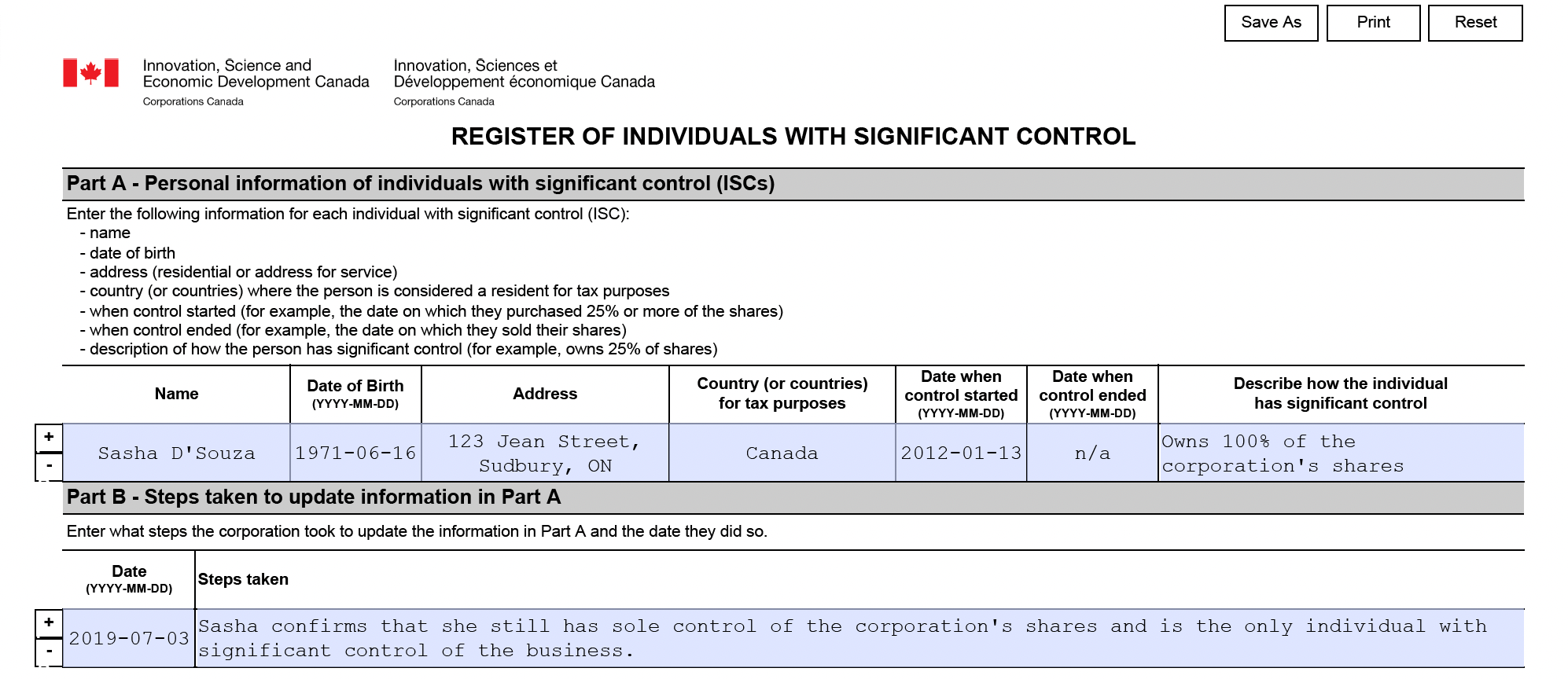
Corporations Canada provides fillable templates you can use as a starting point:
The deadlines you can't miss
Both regimes share the same two timing rules:
- Review the register at least once every financial year. Tie this to your year-end so it doesn't slip.
- Record any change within 15 days of becoming aware of it. A share transfer, a new shareholder agreement, a death, or a change to a trust all start that 15-day clock.
"Reviewing" the register means actively reaching out, not just glancing at the file. Corporations Canada describes the reasonable steps a federal corporation is expected to take:
Your corporation is required to update its register at least once a year, and within 15 days of becoming informed of any changes affecting the register. In the course of maintaining an up-to-date register, your corporation is obligated to take reasonable steps to update information including:
- any information contained in the register that has changed
- ISCs who need to be added or removed
Reasonable steps for updating the ISC register Taking reasonable steps to maintain an up-to-date ISC register includes sending a request for information at least once a year to:
- any ISCs in the register, to confirm or update their information
- all shareholders of the corporation, to ask if they have become an ISC and, if yes, request the required information to add to the register
- any other person that the corporation has reasonable grounds to believe may have relevant knowledge with respect to an ISC over the corporation, or any person who may have relevant knowledge about such a person.
Federal vs. Ontario: the key differences
The "who qualifies," "what to record," and deadline rules are essentially identical. Where the two regimes diverge (and where it really matters) is in filing and penalties.
If you're federally incorporated (CBCA), there's a major extra step. Thanks to changes brought in by Bill C-42, you must now file your ISC information with Corporations Canada: at incorporation, with your annual return, within 15 days of any change, and on amalgamation or continuance. This is a separate obligation from keeping your internal register.
On top of that, since January 22, 2024, a portion of that information is publicly searchable through a free federal registry. The public fields are the person's name, address for service, the dates they became or ceased to be an ISC, and the nature of their control. Sensitive details (date of birth, residential address, citizenship, and tax residence) stay private, and individuals can apply to keep information confidential on safety grounds (ised-isde.canada.ca).
If you're an Ontario corporation (OBCA), life is simpler. There is no government filing and no public registry. You keep the register internally and only have to produce it on request to police, tax authorities, or regulators. Ontario kept its regime deliberately light-touch.
| Federal (CBCA) | Ontario (OBCA) | |
|---|---|---|
| Who qualifies | 25% votes or value, or control in fact | Same |
| Annual review | Yes | Yes |
| Update window | 15 days | 15 days |
| File with government? | Yes: Corporations Canada | No |
| Public registry? | Yes (partial), since Jan 2024 | No |
| Max corporate fine | $100,000 | $5,000 |
| Max individual penalty | $1,000,000 and/or 5 years | $200,000 and/or 6 months |
Who can see your register
Your internal ISC register is not a public document, but federal corporations must disclose it on request to a defined set of people and bodies:
Upon request, however, your corporation must disclose the register to:
- its shareholders and creditors, who must provide an affidavit stating that the information obtained will be used only for matters related to the corporation, for example, to influence voting or to acquire shares
- investigative bodies
- Corporations Canada
This is separate from the federal public registry described above: the public registry shows only a limited subset of fields for CBCA corporations, while the internal disclosure obligation gives shareholders, creditors, and investigative bodies access to the full register. Ontario corporations have neither a public registry nor a filing obligation. They simply produce the register on request to police, tax authorities, or regulators.
The penalties are real
Don't assume "small business" means "small risk." Under the federal rules, a corporation that fails to comply can be fined up to $100,000, and directors, officers, or shareholders who knowingly allow a contravention (or who record false or misleading information) can face fines up to $1,000,000 and/or five years in prison. Corporations Canada can also administratively dissolve a non-compliant corporation.
Ontario's penalties are lower (up to $5,000 for the corporation and up to $200,000 and/or six months for individuals) but they're still nothing to shrug at for a small business.
Common mistakes small businesses make
- Not creating the register at all, assuming it only applies to big companies. It applies to nearly every private corporation.
- Confusing it with the shareholder ledger or minute book. It's a separate record.
- Looking only at direct share ownership and missing indirect control through holdcos, trusts, or agreements.
- Reading the threshold as "25% votes AND value" when it's "or."
- Forgetting to document the annual steps taken: including when the answer is "no ISCs."
- (Federal) keeping the internal register but forgetting to file with Corporations Canada. They're two different duties.
- Missing the 15-day window after a change.
How to stay on top of it
For most small business owners, the hardest part isn't understanding the rules. It's remembering them. The annual review quietly slips past your year-end, a share transfer happens and the 15-day clock runs out, or you keep the internal register but forget the federal filing.
This is where having your corporate records in one organized place pays off. Ribbon Business is built to take this kind of busywork off your plate: its Essentials plan helps you build and maintain your ISC register, keep the required details current, and stay ahead of the annual review and 15-day update deadlines, so a routine compliance task doesn't turn into a six-figure problem.
Whether you use a tool or a calendar reminder and a spreadsheet, the principle is the same: set the review on a schedule, log every ownership change as it happens, and (if you're federal) don't forget the Corporations Canada filing.
A quick disclaimer
This guide is general information, not legal advice. The thresholds, deadlines, and penalty amounts above reflect the rules as we understand them, but you should confirm the current details against the primary sources: the CBCA (laws-lois.justice.gc.ca), the OBCA (ontario.ca), and Corporations Canada's ISC guidance (ised-isde.canada.ca), and speak with corporate counsel if your ownership structure involves trusts, holding companies, or anyone with "control in fact." Provinces other than Ontario (such as B.C. and Quebec) have their own variations, so if you're registered extra-provincially, check those rules too.