How to Change a Corporation's Registered Office Address
 Nicholas Wesley-JamesCEO, Ribbon Business
Changing your corporation's registered office is not the same as updating a mailing address. The registered office is your corporation's official legal address: the place where government and legal mail is sent, and the address that appears on the public business registry. Updating it correctly means filing with the right registry, and then separately updating the CRA, your bank, your licenses, and anyone else who has your old address on file.
This guide covers Ontario and federal corporations, with a focus on the mistake that causes the most trouble: assuming one address update fixes every government and commercial record.
The Short Answer
Most Ontario and federal registered-office notices are free to file and are due within 15 days. The approval and filing depend on the move:
| Scenario | Corporate approval | Filing | Current government fee |
|---|---|---|---|
| Federal, same province | Directors' resolution | Registered-office notice through Corporations Canada | $0 |
| Federal, different province | Special shareholder resolution | Articles of amendment plus registered-office notice | $0 when the qualifying province-only amendment is filed online |
| Ontario, same municipality/geographic township | Directors' resolution | Notice of Change through the OBR | $0 |
| Ontario, different municipality/geographic township | Special shareholder resolution | Notice of Change through the OBR | $0 |
Once the registry filing is accepted, you still need to update your address with the CRA, your bank, your insurer, your business licenses, and anywhere else your old address appears. The corporate registry and the CRA do not share address updates automatically.
Do Not Treat Every Address as the Same Record
| Address | What it means |
|---|---|
| Registered office | The corporation's official legal address on its corporate registry |
| Operating location | Where the business actually carries on day-to-day activities |
| CRA physical address | CRA's record of the physical location where day-to-day activities occur |
| CRA mailing address | Where CRA correspondence is sent; it can differ from the physical address |
| Books-and-records address | Where the business keeps its books and records when different |
Changing the registered office does not automatically mean any of the other addresses changed.
Why You Might Change Your Registered Office
The most common reasons we see:
- You incorporated using your home address and want it off the public registry.
- Your business has moved addresses and your corporate records need to match.
- A founder moved, or the team went remote and no one is at the old address to receive legal notices.
Outdated addresses can mean missed mail. In our 2023 Atlantic Canada mailing test, 10.5% of 190 letters sent to newly incorporated federal corporations came back. Relocations were one of the reasons, alongside incomplete or invalid addresses.
Before You File
A few things to confirm before you submit anything:
- Confirm your jurisdiction. Federal corporations file with Corporations Canada; Ontario corporations file with the Ontario Business Registry. If you're not sure, your incorporation documents will say.
- Confirm the new address is eligible. A registered office must be a physical address in the corporation's required jurisdiction. A PO box alone is generally not acceptable. See Can I use a PO box as a registered office?.
- Confirm the provider permits registered office use. Not every mailbox or coworking provider will let you list their address as your corporation's registered office. Ask explicitly.
- Confirm who can authorize the change. Internal corporate approval rules matter here, and they differ from the registry filing itself:
- Federal: moving within the same province requires only a directors' resolution. Moving the registered office to a different province requires a special resolution of shareholders and articles of amendment.
- Ontario: moving within the same municipality or geographic township requires only a directors' resolution. Moving to a different municipality (still within Ontario) requires a special resolution of shareholders. An Ontario corporation's registered office must remain in Ontario.
- Confirm who can file. The registry filing is usually done by an authorized director, officer or intermediary. Federal online filings use the Corporation Key. Ontario's current OBR setup uses a Company Key, Ontario.ca Login and Ontario Business Account. Since February 1, 2025 the Company Key has been required for all Ontario Business Registry transactions, whether you file directly or via an intermediary. Corporations incorporated before October 19, 2021 may need to request a Company Key from ServiceOntario if they don't already have one.
- Have the exact new address ready. Suite number, street, city, postal code. Match the format the provider gives you.
Federal Corporation Process
For corporations incorporated under the Canada Business Corporations Act (CBCA), the approval and filing path depends on whether you're staying within the same province.
Changing the address within the same province
The articles of a federal corporation specify the province of the registered office, not the street address. So moving within that province is straightforward:
- Pass a directors' resolution authorizing the change of registered office address. Record it in your minute book.
- Go to the Corporations Canada Online Filing Centre.
- Sign in with the corporation number and your Corporation Key.
- Select Change registered office address (this is Form 3: Change of Registered Office Address under the CBCA).
- Enter the new street address. Federal corporations also list a mailing address separately. Update that too if it has changed.
- Review the filing summary and submit. There is no government fee for an address change within the same province. The filing must reach Corporations Canada within 15 days of the change (CBCA s.19(4)).
- Save the filing confirmation and keep it with the corporation's records.
Changing the province of the registered office
Because the province is specified in the articles, moving the registered office to a different province is an amendment of the articles, not just an address update:
- Pass a special resolution of shareholders: under the CBCA, that's at least two-thirds of votes cast on the resolution, or a unanimous written resolution.
- File articles of amendment (Form 4) through Corporations Canada updating the province of registered office. The standard fee for articles of amendment is $200 by mail, but the fee is waived if the only purpose of the amendment is to change the province of registered office (or the number of directors) and the filing is submitted through the Director's online service.
- File the registered office address notice (Form 3) for the new province within 15 days of the change.
- Keep the special resolution and the articles of amendment in your minute book.
Don't confuse the two paths. A within-province move is a board-level decision, while a province change is a shareholder-level decision with a more involved filing.
Ontario Corporation Process
For corporations incorporated under the Ontario Business Corporations Act (OBCA), the internal approval depends on whether the new address is in the same municipality or a different one. The registry filing is the same in either case. What changes is who has to authorize it first.
Changing the address within the same municipality
If the new address is in the same municipality or geographic township as the old one (for example, both in Toronto):
- Pass a directors' resolution authorizing the change (OBCA s.14(3) permits the directors to change the registered office within the same municipality or geographic township). Record it in your minute book.
- Go to the Ontario Business Registry.
- Sign in with your Ontario.ca Login and Ontario Business Account, then access the corporation using its Company Key.
- File a Notice of Change (Form 1 under the Corporations Information Act) with the new registered office address.
- Review and submit. There is no government fee for filing a Notice of Change. Section 4(1) of the Corporations Information Act requires it to be filed within 15 days of the change.
- Download the filed Notice of Change and keep it in your minute book.
Changing to a different municipality in Ontario
If the new address is in a different municipality or geographic township (for example, moving from Toronto to Markham):
- Pass a special resolution of shareholders: under the OBCA, that's at least two-thirds of the votes cast at a duly constituted meeting, or a written resolution signed by all shareholders entitled to vote (OBCA s.14(4)).
- File the Notice of Change through the Ontario Business Registry as above.
- Keep the special resolution and filed Notice of Change with the corporation's records.
An Ontario corporation's registered office must remain in Ontario. Moving the registered office out of the province isn't an address change at all. It requires continuance under another jurisdiction's corporate statute, which is a separate process.
The Ontario Business Registry also requires director and officer information to be kept current. If a director or officer has moved at the same time, file those changes in the same Notice of Change.
Extra-Provincial Registrations
If your corporation is registered to do business in provinces other than its home jurisdiction (extra-provincial registrations), those provinces each maintain their own records. A federal or Ontario filing does not flow through to extra-provincial registers in other provinces.
For each province where you are extra-provincially registered:
- File a corresponding address update in that province's registry.
- Some provinces require a separate Notice of Change form; others let you file online.
- Annual return obligations in those provinces are tied to the address they have on file. Outdated addresses are a common reason for involuntary dissolution.
See our extra-provincial registration overview for province-specific links.
Downstream Updates
Once the registry filings are accepted, work through the rest of your records. None of the below happens automatically.
CRA Business Addresses
CRA keeps separate physical, mailing and books-and-records addresses, including address records associated with business program accounts. Updating the corporate registry does not update CRA.
A note on what this address is used for in 2025 and beyond: as of mid-2025, the CRA defaults business correspondence to online mail via My Business Account rather than paper. Businesses registered for My Business Account (and those with a representative via Represent a Client) were transitioned to online mail by June 16, 2025. Paper-mail address updates still matter for businesses that have opted back into paper (via Form RC681), for non-resident businesses without My Business Account access, and as a fallback when online mail is returned undeliverable. Still, the address-of-record is now most relevant for the in-portal contact information CRA holds for the business, and for the small set of correspondence still sent by mail.
There are three ways to update CRA:
Option 1: CRA My Business Account (recommended).
-
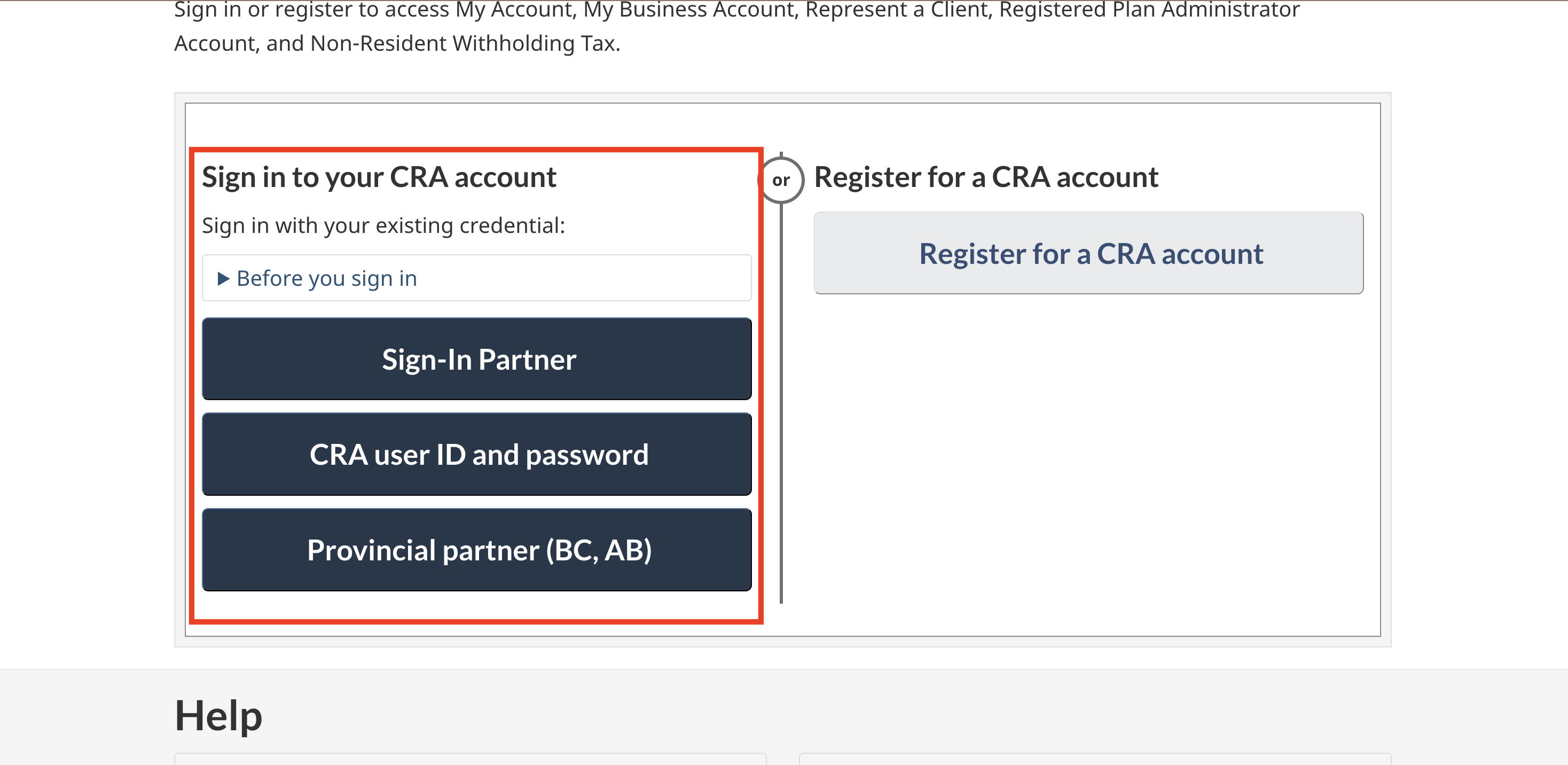
Sign in to CRA My Business Account.
-
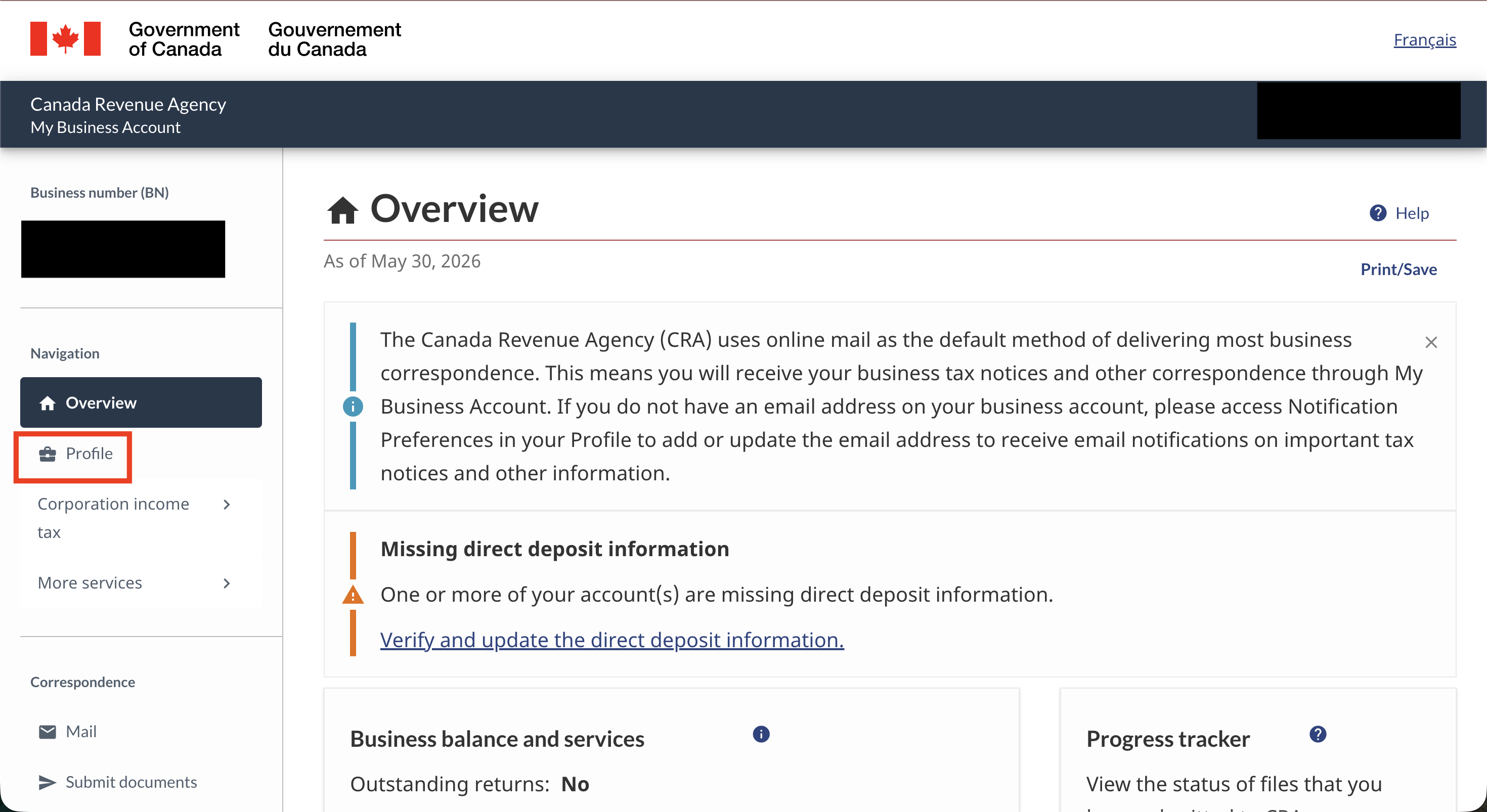
From the dashboard, select your business and open the Profile menu.
-
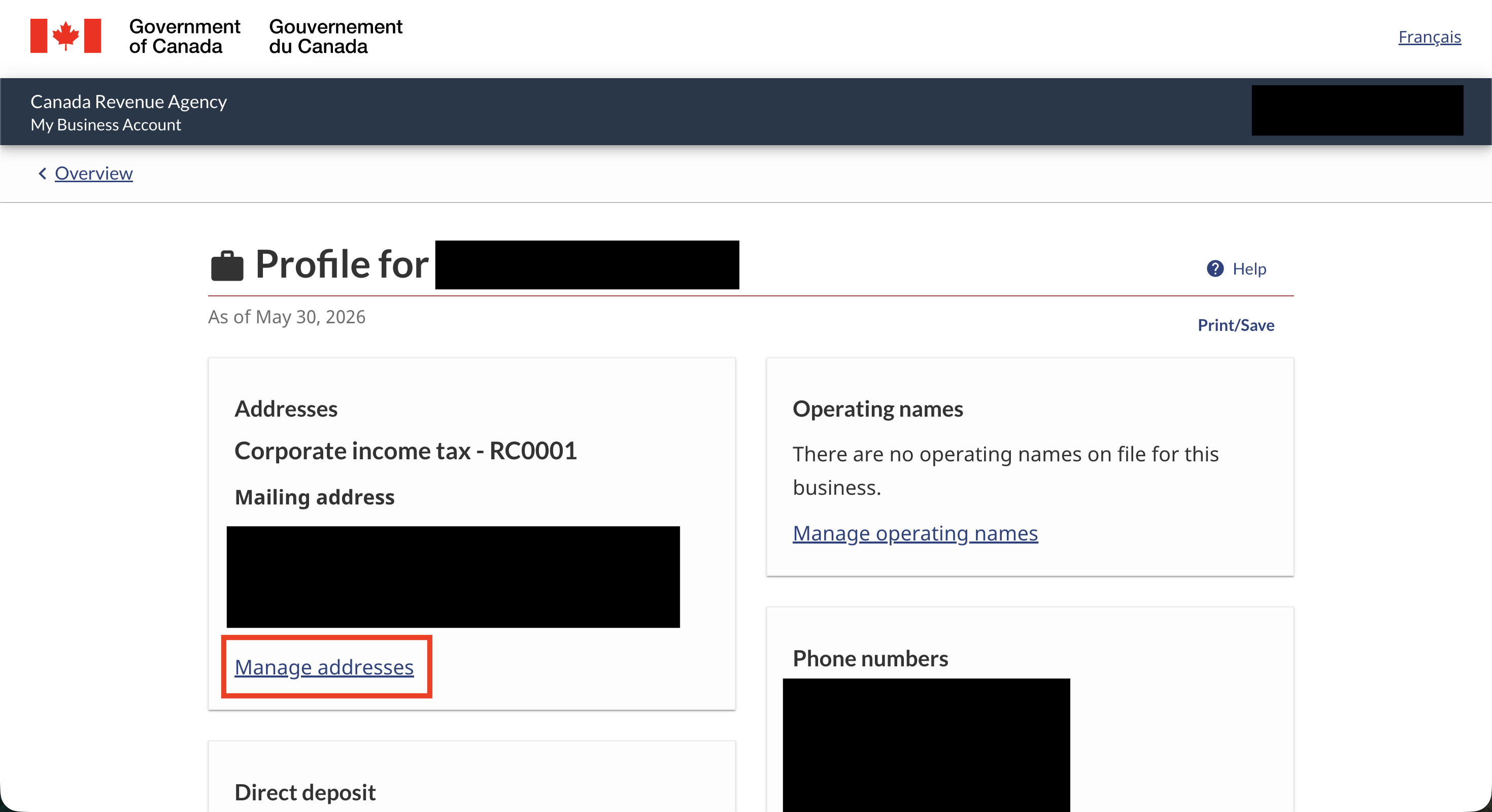
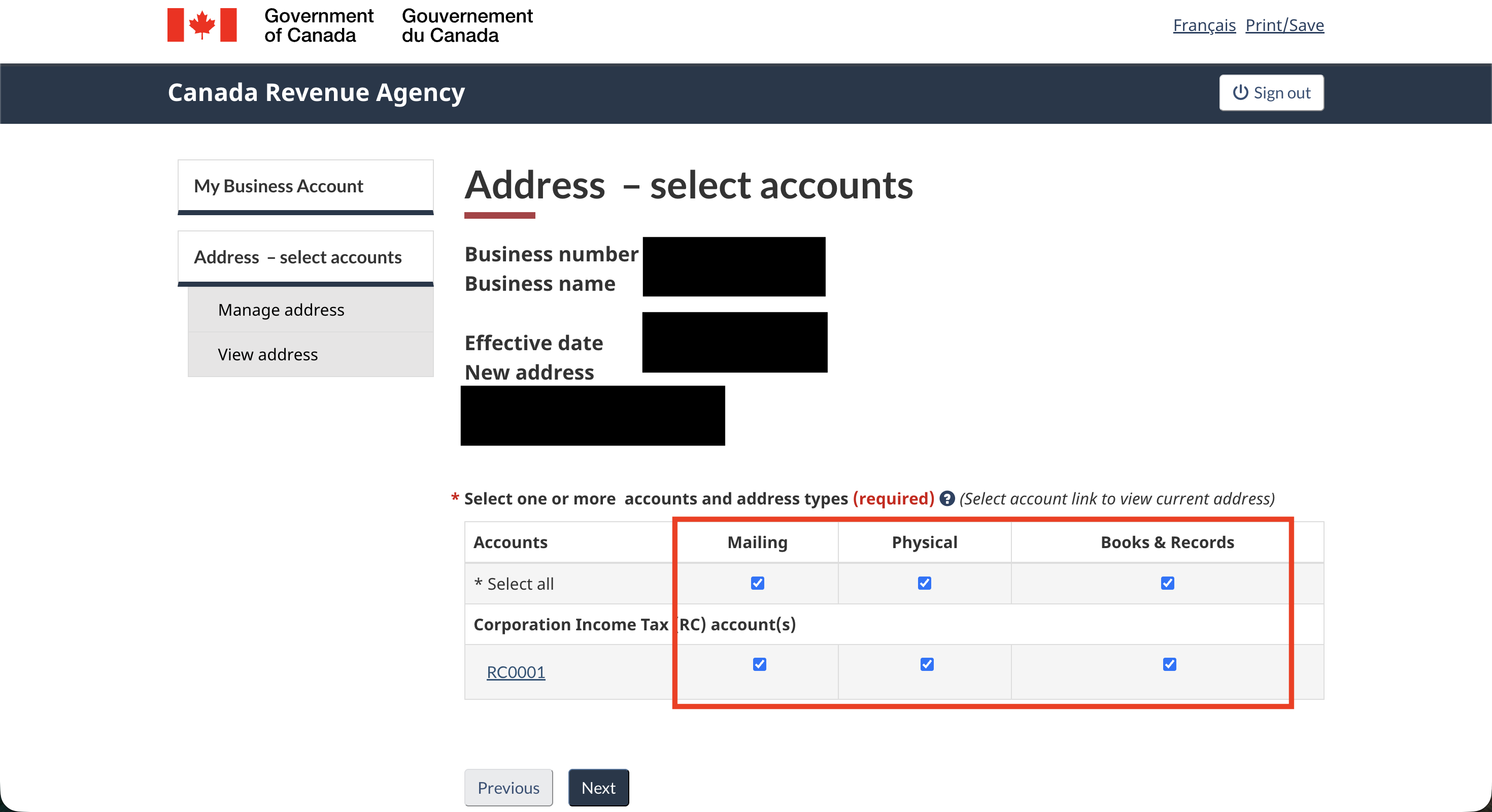
Choose Manage addresses. CRA stores up to three address types per account: physical, mailing, and books-and-records.
-
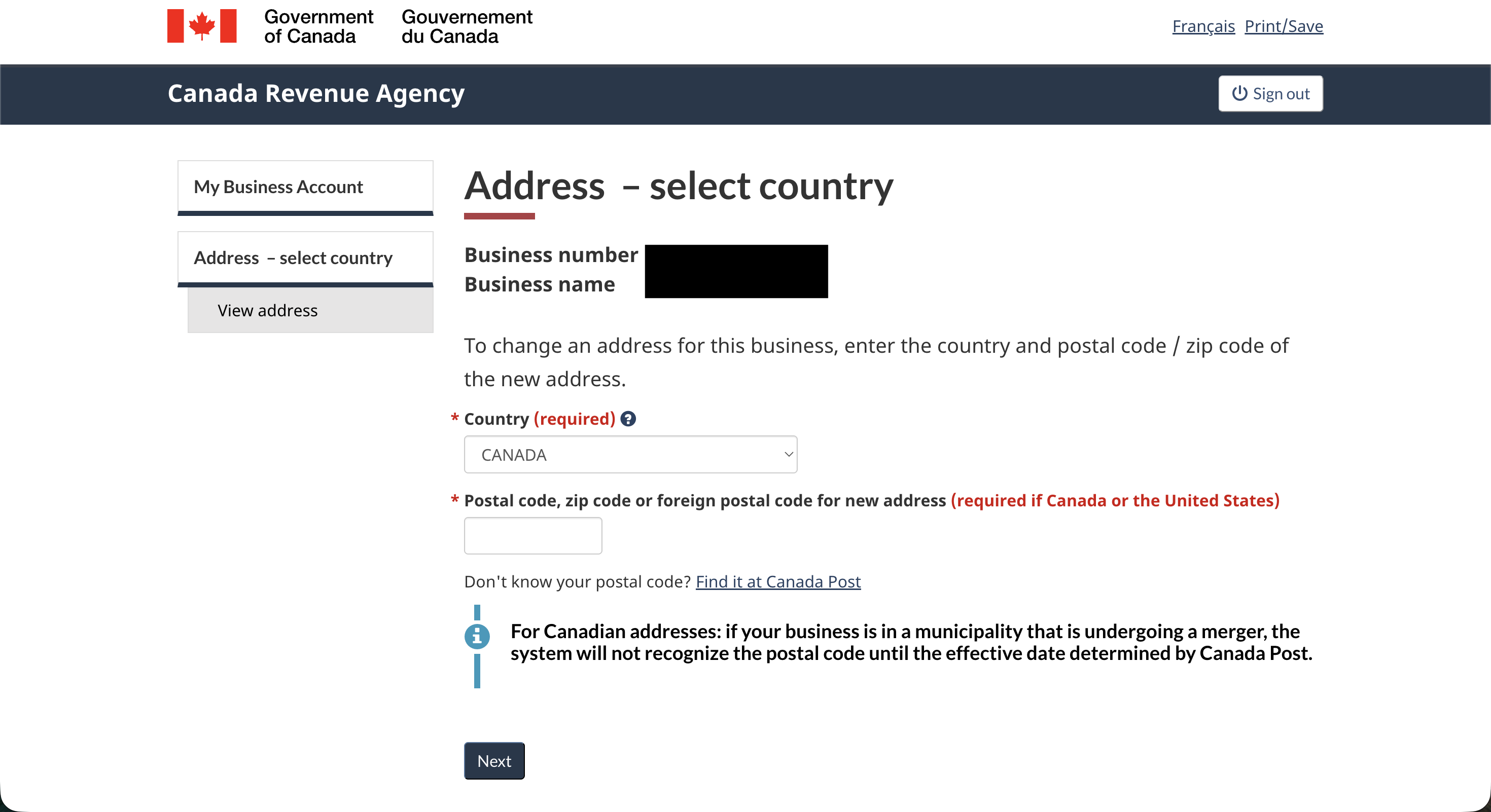
Update only the address types that truthfully changed. A virtual registered office may become the mailing address, but it is not the physical address unless the business's day-to-day activities actually occur there.
-
Apply the change to all program accounts (RT for GST/HST, RP for payroll, RC for corporate tax). CRA does not propagate the change across accounts automatically. You must check the box for each program.
-
Submit. You'll get a confirmation number. Save it.
Option 2: Represent a Client. If your accountant files on your behalf, they can update the address through Represent a Client with the same flow.
Option 3: Phone or letter. Call CRA Business Enquiries at 1-800-959-5525, or send a signed letter to your tax centre listing the business number, every program account that needs to be updated, the new address, and the effective date. (The CRA's individual address-change form, RC325, is for individuals. For a business, the phone, online, or signed-letter routes are the standard options.) Phone and mail updates take longer to reflect on the account.
Bank Accounts
Your business bank account address is independent of both the registry and the CRA. Most banks require a director or signing officer to make the change in-branch or through secure messaging. Update each account separately if you have more than one. Expect the bank to also ask for proof of the current corporate address. In practice, this is often a recent corporate profile report rather than the filing receipt itself. For a federal corporation that means a Corporations Canada profile report; for an Ontario corporation, an Ontario corporate profile report.
Other Records to Update
Work through this list:
- GST/HST account (covered by the CRA update above, but verify it propagated).
- Payroll account (RP) and corporate tax (RC). Again, verify per account.
- Provincial sales tax accounts (where applicable).
- Workers' compensation (WSIB in Ontario, equivalent provincial board elsewhere).
- Business licenses and permits at the municipal level.
- Industry-specific regulators.
- Business insurance (commercial general liability, professional liability).
- Suppliers and recurring vendors.
- Customers who send paper invoices or cheques.
- Website footer, contact page, and About page.
- Email signatures and email templates.
- Invoices, purchase orders, and contract templates.
- Google Business Profile, only if the business and location independently meet Google's eligibility rules.
Common Mistakes
- Updating the corporate registry but not CRA. The most common one. Government cheques and notices end up at the old address for months.
- Updating CRA but not the corporate registry. Now your public business record is wrong, and legal notices may go to the wrong place.
- Forgetting extra-provincial registrations. A federal address change does not update your Alberta or BC extra-provincial record.
- Using a PO box where a physical address is required. Most registries reject PO-box-only addresses for a registered office.
- Using an address without the provider's permission. A coworking space or mailbox provider that does not permit registered office use can create compliance problems later.
- Leaving your home address on the registry "for now." It stays public and crawlable until you file the change.
- Forgetting old invoices and contracts. Auditors and counterparties work from the address on the paperwork in front of them.
How Ribbon Business Helps
Ribbon Business provides a downtown Toronto registered office for eligible Ontario corporations and federal corporations whose articles specify Ontario, with:
- A real physical Toronto address (not a PO box).
- Registered office use permitted, where eligible for your corporation type.
- Government and legal mail scanned for free.
- Virtual mailbox accessible online.
- Mail forwarding available.
- Up to 60 days of mail storage.
- $45 per month.
The address subscription covers the address and mail service. If you also want the registry change handled, Ribbon’s corporate annual returns and compliance service includes registered office updates, annual returns, and corporate records for Ontario corporations and federal corporations across Canada except Quebec. Government fees are additional. CRA, bank, and other account updates are separate from the corporate registry filing.
FAQ
Does updating my registered office update my CRA address?
No. The corporate registry and CRA maintain separate records. Review CRA's physical, mailing and books-and-records addresses and update only the records that truthfully changed.
How much does it cost to change a registered office address?
A federal same-province address notice and an Ontario Notice of Change currently have no government filing fee. A qualifying federal online amendment that changes only the province of registered office is also currently free.
How quickly must a corporation report the change?
Federal and Ontario corporations generally must file the applicable notice within 15 days of the change.
Can an Ontario corporation use a virtual office as its registered office?
Yes, when the corporation is entitled to use the Ontario location, the provider permits registered-office use, and legal and registry documents can be received there. See the Ontario virtual-office guide.
How long does a registered office change take to appear publicly?
Federal filings are typically reflected on the public registry within one to two business days. Ontario filings are usually visible shortly after the Notice of Change is filed through the Ontario Business Registry.
Do I have to tell my bank?
Yes. Banks do not pick up registry changes automatically and will continue mailing statements and tax slips to the old address until you update each account.
What if mail is already returning from my old address?
File the registry change immediately, then update CRA and the bank. Canada Post mail forwarding from the old address can act as a temporary bridge while everyone else catches up.
Primary Sources
- Canada Business Corporations Act, section 19: federal approval and 15-day notice requirement.
- Corporations Canada services, fees and processing times: current federal fees.
- Ontario Business Corporations Act, section 14: same-municipality and different-municipality approvals.
- Ontario Business Registry: current account and Company Key route.
- CRA: change a business address: physical, mailing and books-and-records definitions.